Nobi vs Algolia: which AI site search is better for ecommerce?
Nobi and Algolia are built for different buyers. Nobi is a no-code AI site search with a built-in conversational shopping assistant, purpose-built for ecommerce - semantic relevance on by default, fast response times, and site installs measured in hours. Algolia is a developer-first search API with sub-50ms latency, a massive ecosystem of InstantSearch UI libraries, and deep control over ranking, indexing, and the storefront frontend. It's built for engineering teams who want to own the search experience end-to-end:
- Nobi - AI site search plus a shopping assistant and automatic answers for shopper questions in one platform, from $25/mo for 500 messages (a search or a chat question each count as one message), with conversational filtering. Pick it when you want relevance that works without weekly rule-tuning, and you need to be live in hours.
- Algolia - developer-first search infrastructure with deep APIs, SDKs, and InstantSearch UI libraries; pricing starts free (Build) and scales with queries, records, and AI-tier add-ons. Pick it when you need custom ranking rules, a bespoke storefront frontend, or AI vector search your engineering team wires in and owns.
| Product | Primary job | Best for | Pricing (starting) | Standout strength | Key weakness |
|---|---|---|---|---|---|
| Nobi | AI site search + shopping assistant for ecommerce | Teams who want relevance and conversational discovery without engineering build-out | From $25/mo for 500 messages (a search or a chat question each count as one message) | Highly relevant product search and ecommerce-first UX out of the box; AI answers using your knowledge base | Smaller integration marketplace than Algolia; not an API-first developer platform |
| Algolia | Search and discovery API infrastructure | Engineering teams building a custom search UI with full control over ranking | Free Build (dev) plan; Grow from $0.50 per 1K searches + $0.40 per 1K records; NeuralSearch (AI relevance) is Elevate-tier only | Deep APIs, SDKs, and InstantSearch libraries; sub-50ms hosted infra; strong typo tolerance, faceting, and filtering on the keyword engine | Implementation and ongoing relevance tuning need engineering time; query + record + AI-tier pricing compounds at volume |
What's the core difference between Nobi and Algolia for ecommerce site search?
Algolia is heavily optimized search infrastructure; Nobi is a finished ecommerce search product. Algolia ships APIs, SDKs, and InstantSearch UI components that your engineering team assembles into a search experience you own end-to-end. Nobi ships a working semantic search experience and a conversational shopping assistant that are ready to go as soon as it loads up your product catalog.
Algolia is the right pick when you have engineering capacity and a specific ranking, faceting, or UI pattern you need to control. Its AI relevance layer, NeuralSearch, is a separate add-on and isn't included on every pricing plan, so teams that want semantic search have to opt into that tier. Implementation is an engineering project: APIs, SDKs, and InstantSearch components assembled into the finished search UI, then maintained as the catalog and ranking needs evolve. Nobi comes with semantic relevance and the shopping assistant included, so it's the faster path to a working AI search experience for teams that don't have an engineering owner for search.
How do Nobi and Algolia compare on pricing?
Nobi starts at $25 a month for 500 messages, where a search or a chat question each count as one message. Bigger bundles cost less per message, up to 100,000 messages for $2,999 a month. One usage-based line item. Algolia has four tiers that each unlock different capability sets:
- Build (free, dev-focused) - up to 10K searches and 1M records per month, full feature access for building and testing. It's a dev plan - not intended for production traffic.
- Grow - production keyword search at $0.50 per additional 1K search requests and $0.40 per additional 1K records beyond the included bands.
- Grow Plus - Grow's pricing plus AI Synonyms, AI Ranking, Advanced Personalization, and a larger rules library. Still keyword-based at the core.
- Elevate - annual enterprise contract, volume-based discounts, and the only tier that includes NeuralSearch (Algolia's vector-based AI relevance layer) alongside SSO, 99.999% SLA, and real-time personalization.
Algolia's pricing rewards low-volume stores: under 10K searches a month on the Build tier with no NeuralSearch, it's effectively free. It gets expensive when volume, record count, and AI relevance all scale together, because each is metered separately. A catalog with 500K records and 500K monthly searches on Grow pays $245 for the search overage above 10K (490 × $0.50) plus $160 for the record overage above 100K (400 × $0.40), so roughly $410 a month - and that's still keyword-only. Turning on AI vector relevance means stepping up to Elevate and negotiating an annual enterprise contract with Algolia's sales team.
Nobi's bill is one usage-based line: a message bundle from $25/month for 500 messages, where a search or a chat question each count as one message. A busier month is billed at the bundle that fits. No per-record indexing fee, no AI-relevance upcharge, no revenue-share. The trade-off is breadth: Nobi is a finished search and conversational discovery product, not an API-first platform for teams that want to build their own ranking stack.
Which delivers better AI relevance out of the box?
Nobi ships semantic relevance as the default behavior. Brand-voice or creative catalog naming - common in fashion, beauty, and home goods - is searchable without merchandisers maintaining a synonym list or filing tuning tickets. Algolia's keyword engine is fast and configurable, but its AI relevance layer (NeuralSearch and Dynamic Re-Ranking) sits in a higher tier and needs an engineering team to wire it in and tune it against query logs.
Nobi's semantic layer runs without a rule library. Kilte, a DTC fashion brand on Shopify, saw a 21.7% conversion lift in an A/B test against Shopify's default search after switching to Nobi. The shopper-to-catalog vocabulary mapping is automatic, so merchandisers aren't hand-pinning products to queries every week just to keep results relevant.
Algolia's base product is a tokenized keyword engine with strong filtering, faceting, and typo tolerance - the foundations of fast search at scale. Its AI relevance lives in NeuralSearch, which combines keyword matching with vector-based semantic search and is only available on the Elevate plan (annual enterprise contract). NeuralSearch is an opt-in layer that engineers wire in and tune against query logs, so semantic relevance is configured rather than enabled by default. It's the best fit when an engineering team wants to own ranking logic, query-log tuning, and a custom frontend.
One honest concession: if your team wants to build bespoke ranking rules or embed search inside a highly custom frontend, Algolia's developer platform is the right pick for that work.
How do implementation and ongoing engineering requirements compare?
Nobi installs in hours on any ecommerce site with a public catalog. For Shopify stores, it ingests your catalog automatically with no extra work on your end. Drop the search bar into your theme and the assistant starts working - no custom frontend code, no modeling search records by hand. Other platforms use a lightweight script and a catalog connector on a similar timeline. Algolia is a build project. An engineering team integrates the API, models index records, configures ranking rules, and assembles a search UI from InstantSearch libraries - then keeps maintaining all of it as the catalog and ranking needs change. Both vendors run hosted infrastructure - the difference isn't where the search runs, it's what the brand has to build and own on top of it.
Algolia gives engineering teams precise control over how search behaves. Records, attributes, ranking formula, typo tolerance, synonyms, faceting, and the frontend search UI are all configurable, and a team that wants to write their own ranking logic or embed search in a custom storefront has the tools to do it. The trade-off is the work itself. Setup means schema design, indexing pipelines, ranking configuration, and a frontend assembled from InstantSearch components. Catalog changes typically mean reindexing and re-tuning ranking. Ongoing relevance work sits with whoever owns the integration. It's the best fit when the brand has engineering capacity to own setup and keep the system tuned over time. Maintenance is ongoing, not a one-time job.
Nobi takes the opposite approach. The platform ships as a finished search experience - semantic relevance, the conversational assistant, the search UI, and merchandising controls are all built in. The assistant adapts as your catalog updates without a reindex-and-retune cycle. Faster implementation than enterprise alternatives is the point. The honest limit: Nobi is not an API-first developer platform. Teams that want to write custom ranking logic or build search into a fully custom frontend will prefer Algolia. Teams that want a working AI search experience live in hours, with merchandisers (not engineers) tuning it from there, are the ones Nobi is built for.
How do merchandising and personalization controls compare?
Both products ship merchandising controls. The difference is whether merchandising is the mechanism you use to get acceptable relevance, or an optional overlay on a semantic layer that already works.
Algolia's Merchandising Studio is built for teams who want explicit control. A merchandiser can pin products to a query, create rules that promote or demote items based on attributes or inventory status, and A/B test variants to see which ranking performs better. Personalization sits in Algolia Recommend and is configured and priced as a separate product. Because Algolia's base engine is keyword search, the merchandising library is how you get relevance-tuned results for your catalog. Rules are human-maintained and the library compounds over time as queries and products evolve ("always promote new arrivals on 'summer dress' queries through June 30").
Nobi ships its own merchandising controls: hide, boost (weak/medium/strong), bury (weak/medium/strong), and slot products into specific positions. You can set conditions on product attributes, search queries, visitor location, and date ranges for time-bound campaigns. These sit on top of Nobi's semantic layer as overrides rather than as the primary mechanism for good results. The default behavior works out of the box (Kilte's 21.7% CVR lift was delivered with no custom rules), so merchandisers step in when they have specific business logic - "always promote new arrivals on summer dress queries through June 30," "hide products out of stock in this region," "slot this SKU into position two for 'gift' queries through Valentine's Day." Operational load stays low because rules layer on top of a working default rather than replacing one.

Kilte uses Nobi across three discovery surfaces - the search bar, collection filters, and product discovery - so the same semantic layer compounds wherever shoppers land. One limit worth naming: Nobi curates the search results page rather than site-wide category and collection pages, so brands running hand-tuned collection grids for seasonal campaigns (the Valentine's edit, the back-to-school capsule) still pair it with a dedicated tool for those pages.
How do analytics and reporting compare?
Algolia's analytics are search-infrastructure metrics: query volume, top queries, click-through rates, zero-result queries, conversion events tied to searches. These metrics are useful for engineers tuning relevance, but they don't tell you what customers actually want or what's moving in the catalog. Revenue attribution, A/B testing, and Dynamic Re-Ranking models live in the Grow Plus and Elevate tiers.
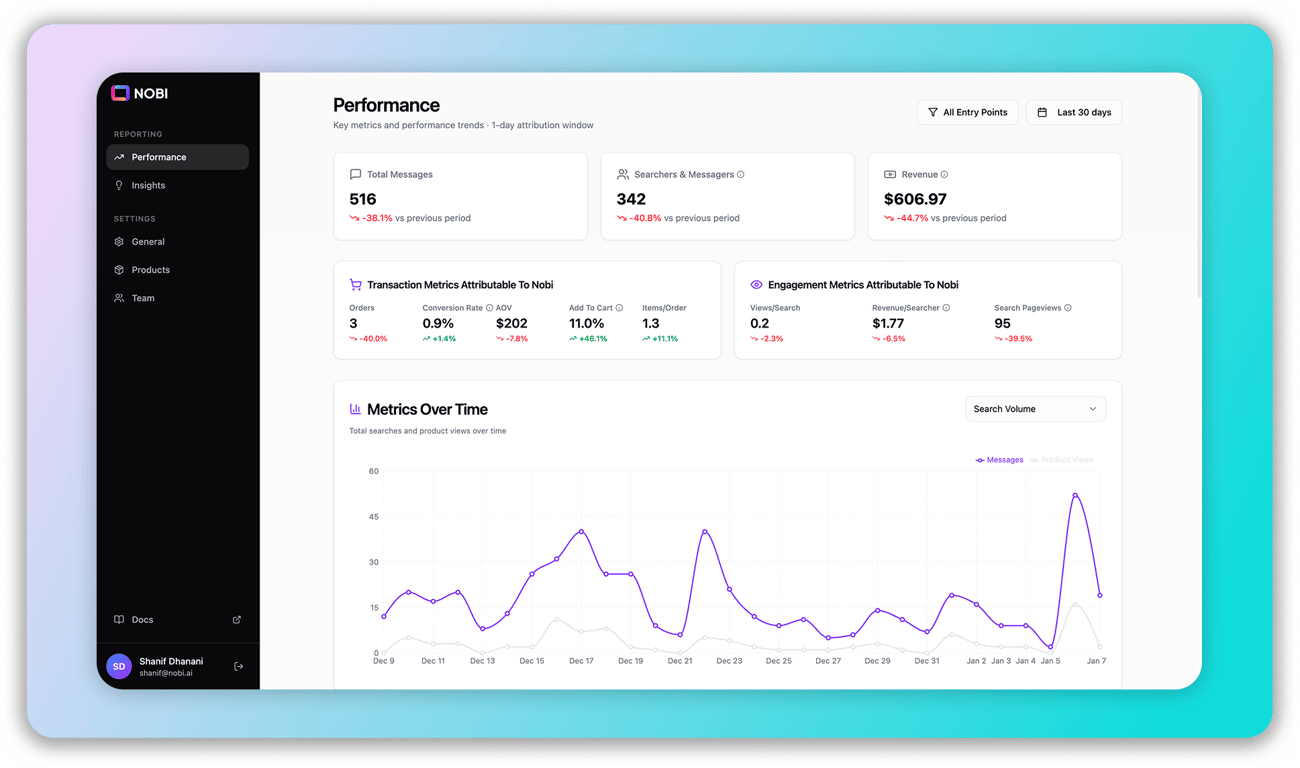
Nobi's reporting is built for the ecommerce team rather than the engineering team. The Performance Metrics view leads with business KPIs: attributed revenue and orders within 24 hours of a Nobi interaction, conversion rate, AOV, add-to-cart rate, revenue per searcher, and a time-series view of how each number is moving. A Queries by Channel breakdown shows which traffic sources (organic, paid social, email, direct) drive search revenue, so marketing and merchandising can see which channels are converting through search.
The Insights view is where the reporting earns its keep. Nobi classifies every query into intent categories (product searches, recommendation requests, information questions, collection browsing, product comparisons), groups related queries into topics (waterproof gear, gift ideas, sizing questions, sale searches), surfaces trending queries before they're obvious from raw volume, and flags high-volume queries with low conversion as merchandising-optimization candidates. Attribute frequencies tell you what customers prioritize most - color, size, material, price, style, fit - so merchandising decisions come from real data, not guesswork.
!Nobi Insights view showing query topic grouping, trending indicators, and sample queries per topic

This is where UNTUCKit uses Nobi's Insights reporting in its weekly merchandising meetings: the team pulls that week's trending queries, sees which product categories are heating up and which are cooling off, and adjusts collection priorities and product staffing from there. That's a different kind of tool than a search analytics dashboard - search is the input, but the output is actionable merchandising data.
When is Algolia the better choice over Nobi?
Algolia is the right call when an engineering team is going to own the search experience and wants full control over how it's built. If your roadmap includes a custom-ranked search UI, your developers want to express ranking logic in code, you're already running Algolia in other parts of your stack, or you need a third-party integration marketplace broader than what a newer vendor can offer, Algolia fits the job better than Nobi.
Algolia is built as a search API first and a merchandising tool second. The strength shows up when an engineering team wants to write ranking rules, custom logic, and UI components in code rather than configure them in a dashboard. Pricing scales with that posture: a free Build plan covers 10K search requests and 1M records per month, Grow charges $0.50 per additional 1K requests plus $0.40 per additional 1K records, Grow Plus adds AI Synonyms, AI Ranking, and Advanced Personalization at the same per-request rate, and Elevate is an annual enterprise contract (the only tier that includes NeuralSearch, the AI vector-relevance layer). The honest weakness is that the developer-first platform means ongoing work for the engineering team that owns it. Relevance tuning, rule maintenance, and ranking iteration are ongoing engineering responsibilities, not one-time configuration. It's the best fit when the brand has dedicated search engineers, wants maximum control, and has the budget to maintain the system over time.
Nobi is the wrong tool for that job and we'll say so plainly. Nobi is not an API-first developer platform - teams building bespoke frontends with hand-coded ranking logic will hit the ceiling fast. Nobi's third-party integration marketplace is also smaller than Algolia's, which matters if your stack already standardises on Algolia connectors elsewhere. Pick Nobi when you want search relevance to work without an engineering owner; pick Algolia when you have one.
When is Nobi the better choice over Algolia?
Nobi is the right call when on-site discovery is the bottleneck and the team buying the tool sits on the ecommerce or merchandising side, not engineering. Brands that need semantic relevance, a conversational shopping assistant, and automatic support answers can get all three with Nobi. There's no quarterly rule-tuning cycle and no separate AI add-on bill. UNTUCKit moved its full search traffic to Nobi after a two-month A/B test showed a 17.1% conversion rate lift (17.6% vs. 15.0%) and 21.3% more revenue per searcher ($39.17 vs. $32.30).
Nobi fits ecommerce teams whose primary friction is search relevance and who don't have dedicated engineering capacity to maintain a search stack. The product ships AI relevance, personalization, and a conversational assistant in one platform. Pricing is usage-based: Nobi starts at $25 a month for 500 messages, where a search or a chat question each count as one message. Bigger bundles cost less per message, up to 100,000 messages for $2,999 a month. No revenue-share, no per-seat fees, no separate invoice when you want the AI features turned on. Implementation is days on Shopify, and merchandisers don't spend their week hand-pinning products to queries just to keep results relevant. One honest limit: Nobi curates the search results page, not category or collection pages. Brands that need merchandising across the full site will still pair it with a dedicated tool.
How should a head of ecommerce choose between Nobi and Algolia?
The decision usually comes down to three variables: who's doing the implementation work, how you want the bill to scale, and whether you need AI relevance on day one.
Engineering capacity. If your team has dedicated search engineers who want to own ranking rules, tune the engine against query logs, and build a custom search UI from InstantSearch components, Algolia is the right pick. It's built for exactly that kind of work. If the team buying the tool sits on ecommerce or merchandising, and the goal is getting AI search and a shopping assistant live in hours without filing an engineering ticket, Nobi is the faster path.
How the bill scales. Algolia's bill has three dimensions (searches, records, and AI-tier contract) that compound at volume. A 500K-record catalog doing 500K monthly searches on Grow pays $245 for the search overage above 10K (490 × $0.50) plus $160 for the record overage above 100K (400 × $0.40), so roughly $410 a month - and that's still keyword-only. Turning on AI vector relevance means stepping up to Elevate and negotiating an annual enterprise contract with Algolia's sales team. Nobi's bill is one usage-based metric: messages, where a search or a chat question each count as one message. Bundles run from 500 messages for $25 a month up to 100,000 messages for $2,999 a month, and a busier month is billed at the bundle that fits.
AI relevance on day one. Algolia's semantic search (NeuralSearch) is an Elevate-only enterprise-contract feature, so AI relevance is a plan upgrade rather than a default behavior. Nobi ships semantic relevance on every tier by default. That matters most for brands with creative product naming, where keyword search would fail without a large synonym list.
Algolia is the better pick when you need engineering-owned ranking logic, a custom storefront frontend, or you're already running Algolia elsewhere in your stack. Nobi is the better pick when time-to-launch, merchandiser-owned relevance, and a single predictable bill are what matter.
Frequently asked questions
A few questions come up every time a head of ecommerce compares Nobi and Algolia for site search: how AI relevance is priced, whether either tool replaces a merchandising platform, what migration actually looks like, and how a conversational shopping assistant fits in. Short answers below.
Does Algolia's free tier include AI relevance? No. Algolia's free Build plan covers keyword search up to 10K requests and 1M records per month. NeuralSearch, Algolia's AI vector search layer, is only available on the Elevate tier (annual enterprise contract). If AI relevance is the reason you're evaluating, budget for the Elevate contract rather than the free tier.
Will Nobi or Algolia replace a full merchandising tool? Neither covers site-wide collection-page merchandising. Both focus on the search results page. Brands that need to merchandise category and collection pages beyond search typically pair their search tool with a dedicated merchandising platform. That said, Nobi includes merchandising controls for the search results page itself.
How long does migration take? Nobi installs in hours on Shopify via the app. Algolia ships through its official Shopify integration plus storefront engineering work, and teams commonly spend weeks to months depending on how much custom ranking, faceting, and UI work they want.
Does Algolia include a conversational shopping assistant? No. Algolia is search infrastructure. A conversational discovery layer is a separate build on top, using Algolia's APIs plus an LLM. Nobi ships site search and the conversational assistant together in one platform.
---
If semantic relevance and a shopping assistant running against your own catalog in hours sounds like what you need, <a href="https://dashboard.nobi.ai">try Nobi free for 30 days</a>.
<div className="my-8 flex justify-center"> <a href="https://dashboard.nobi.ai" className="inline-flex items-center justify-center gap-2 rounded-2xl font-medium transition active:scale-[.98] focus:outline-none focus-visible:ring-2 focus-visible:ring-black/10 dark:focus-visible:ring-white/20 bg-black text-white dark:bg-white dark:text-black hover:opacity-90 shadow-sm h-12 px-6 text-base no-underline" > <span>Start your free Nobi trial</span> </a> </div>