There's a dirty secret in ecommerce UX: the filter sidebar that every store has was designed for people who already know what they want.
Size: Medium. Color: Blue. Material: Cotton. Price: Under $50. Apply filters. Browse results.
This works beautifully - if you're looking for a specific medium blue cotton shirt. But here's the problem: that's not how most people actually shop.
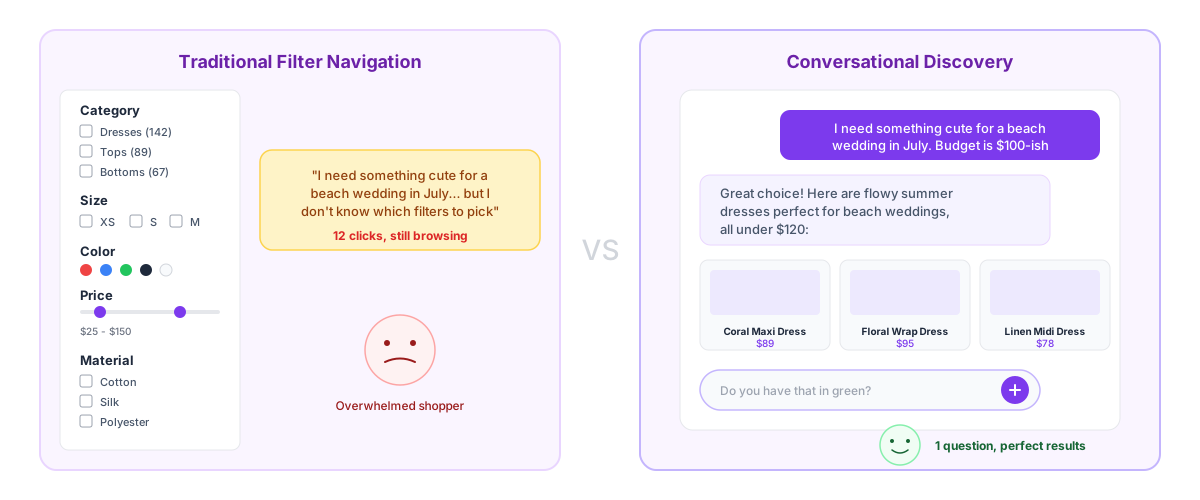
Most shoppers show up to your store with something much vaguer in their heads. "I need something cute for a wedding." "My living room needs... something." "Gift for my brother who's impossible to buy for."
Try expressing any of those through a filter sidebar. You can't. And that's why filters, while useful, leave an enormous gap in product discovery that most ecommerce stores don't even know exists.
!Filter sidebar mockup vs conversational search
The Discovery Spectrum: From Precision to Exploration
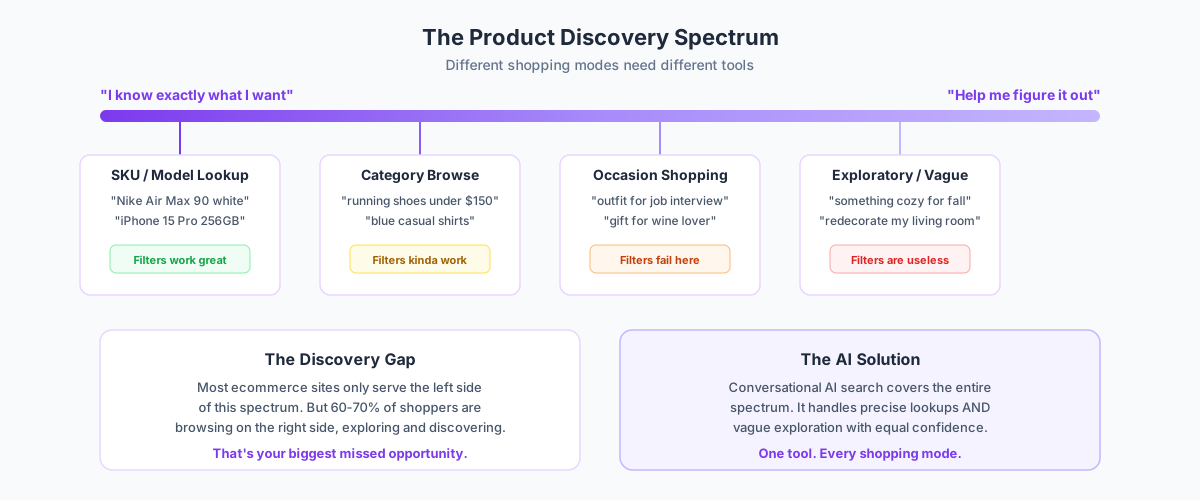
Think of shopping behavior as a spectrum. On one end, you have precise, known-item lookup. On the other, you have vague, exploratory browsing. Most shopping sessions fall somewhere in between.
Known-item search ("Nike Air Max 90 white size 11") is the easiest to serve. Filters nail this. Search bars with basic keyword matching nail this. The shopper knows exactly what they want and just needs to find it.
Category browsing ("running shoes under $150") works reasonably well with filters. The shopper has a general idea and can use categories, price ranges, and basic attributes to narrow down.
Occasion shopping - "outfit for a job interview" or "gift for a wine lover" - is where filters start to break down completely. There's no "occasion" filter on most stores. There's no "vibe" filter. The shopper has to mentally translate their intent into your filter vocabulary, and most give up.
Exploratory shopping ("something cozy for fall" or "redecorate my bedroom") is where filters are completely useless. The shopper is browsing for inspiration, and clicking through Size/Color/Material dropdowns doesn't inspire anyone.
!The product discovery spectrum
The Numbers Behind the Gap
Here's where it gets expensive. Research from the Baymard Institute shows that 72% of ecommerce sites fail to meet basic search and discovery expectations.
The typical breakdown of shopping sessions:
- 30-40% are known-item or category searches (well-served by filters)
- 60-70% involve some form of exploration, browsing, or uncertainty (poorly served by filters alone)
That 60-70% represents the discovery gap. These are shoppers on your site, often with money to spend, who can't effectively find what they need because your only discovery tools were built for the other 30-40%.
And the revenue impact is significant. Opensend data suggests that search users convert 2-3x higher than browsers, but only when search actually works for their query type. When it doesn't, 80% leave the site entirely.
Why Filters Fail at Discovery
Filters are great tools. They just have fundamental limitations that make them inadequate as your only discovery mechanism.
Filters Require Domain Knowledge
To use filters effectively, a shopper needs to understand your category structure, your attribute taxonomy, and your naming conventions. They need to know that what they call a "couch" you call a "sofa," that what they think of as "casual" maps to your "everyday" category.
This is backwards. Your store should understand the shopper, not the other way around.
Filters Are Reductive, Not Additive
Filters work by eliminating options. Start with 2,000 products, filter to Women's, filter to Dresses, filter to Size M, and now you have 47. That's useful for narrowing down.
But what if the shopper's problem isn't too many options? What if their problem is "I don't know what I'm looking for"? Reducing options doesn't help with inspiration. It just gives you fewer things to be uninspired by.
Filters Can't Handle Context
"Something warm for a winter wedding" requires understanding that "winter wedding" implies formal attire in heavier fabrics, probably in darker or richer colors, likely not casual knitwear despite being "warm."
No filter combination captures this. The shopper would need to select Dresses > Formal > Long Sleeve > Winter Colors and hope for the best. Three clicks in, most have already left.
Filters Create Decision Fatigue
A well-intentioned product team adds filters for every attribute: size, color, material, price, brand, style, occasion, sleeve length, neckline, fit, sustainability certification. The result? A sidebar with 15 filter groups that overwhelms shoppers instead of helping them.
Research from Hick's Law tells us that decision time increases logarithmically with the number of choices. Every filter you add makes the filtering interface harder to use.
Modern Discovery: Beyond the Sidebar
The solution isn't to remove filters. They serve their purpose for known-item search. The solution is to layer additional discovery mechanisms on top.
Conversational Search
Let shoppers describe what they need in natural language. "Comfortable work shoes for someone who stands all day" should surface arch-support shoes, cushioned insoles, and ergonomic footwear, without the shopper needing to know those terms.
This is the single biggest unlock for ecommerce discovery. It bridges the gap between how people think about products and how your catalog is organized.
Guided Selling
For categories where shoppers need help, guided selling asks a few questions and narrows the selection intelligently. "What's the occasion?" "What's your style preference?" "What's your budget?" Three questions that replace twelve filter groups and feel more like a helpful salesperson than a database query interface.
Contextual Recommendations
"Shoppers who searched for X also bought Y" is more useful than any filter for exploratory shopping. If someone is browsing wireless earbuds and your site surfaces a popular charging case alongside the results, you've added value that no filter sidebar could provide.
Visual Discovery
Sometimes shoppers know what they want when they see it but can't describe it in words. Visual search - searching by image or by aesthetic similarity - opens up discovery for the "I'll know it when I see it" crowd.
When Filters Help vs. When They Hinder
This isn't an either/or decision. The best ecommerce experiences use filters and conversational discovery together.
Use filters when:
- The shopper has specific attribute requirements (size, color, price)
- Your category structure is clear and intuitive
- The shopper is narrowing within a known category
- Technical specifications matter (electronics, appliances)
Use conversational discovery when:
- The shopper's query is vague or intent-based
- The shopper doesn't know your category structure
- The shopping occasion drives the purchase (gifts, events)
- The shopper is exploring or seeking inspiration
- The query involves subjective criteria (comfortable, stylish, cozy)
For more on how search directly impacts your bottom line, see our piece on the true cost of bad ecommerce site search. If you're thinking about how Amazon handles this challenge, we cover that in how to stop losing customers to Amazon's search.
The Competitive Advantage of Discovery
Here's the thing about filters: every store has them. They're a commodity. Having great filters doesn't differentiate you because Shopify, WooCommerce, and every other platform provides them out of the box.
But conversational discovery? AI-powered product finding? Natural language search that understands "gift for my girlfriend who likes hiking"? That's rare. That's differentiation. That's the experience that makes shoppers think "this store gets me" instead of "this store is just another grid of products."
The stores winning in 2026 aren't the ones with the best filter sidebars. They're the ones that understand discovery is a spectrum and serve every point on it.
Your filters are fine. They're just not enough.
FAQ
{meta.faqItems.map((item, index) => ( <details key={index}> <summary>{item.question}</summary> <p>{item.answer}</p> </details> ))}