For years, AI in retail lived in pilots, demos, and conference decks. In 2025, that changed.
Across fashion, home, and electronics, U.S. ecommerce brands moved from "AI as innovation theater" to AI as infrastructure. The data from 2025 shows a clear shift: fewer moonshots, more production tools tied directly to revenue, margin, and labor efficiency.
This post breaks down:
- The most common AI applications retail brands deployed in 2025
- Which brands were most active in adopting AI
- Where AI delivered the biggest, provable ROI
- What this tells us about where retail AI goes next
---
Most common AI applications deployed in 2025
When you categorize every publicly announced AI deployment by U.S. retail brands in 2025, a pattern jumps out immediately:
Retailers didn't bet on one "killer AI feature." They deployed AI everywhere friction already existed.
AI Use Cases by Category (2025)
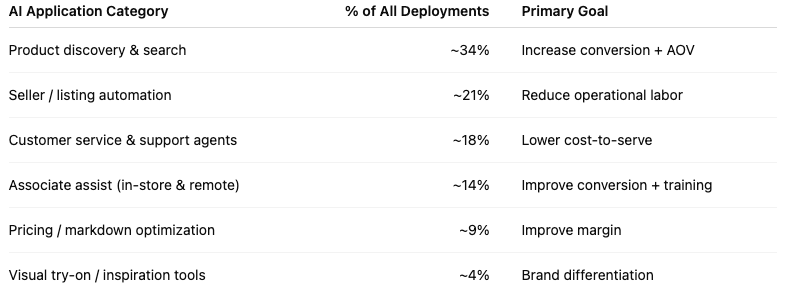
Discovery became the #1 AI investment area for one simple reason, as brands moved toward product discovery that goes beyond static filters:
Search was already broken -- and LLMs finally made it fixable.
We've seen this first hand at Nobi, where replacing a brand's existing search bar with LLM-powered site search typically drives a 29% improvement in CVR within a week.
Examples from 2025 include:
- Wayfair - Muse: visual + conversational browsing for home
- Home Depot - Magic Apron: project-based product discovery
- Nordstrom - AI Gift Expert: guided gifting flows
- Best Buy - conversational search pilots using natural-language filtering
These weren't novelty chatbots. They were embedded, conversion-aware systems tightly coupled to catalog data, inventory, and search merchandising rules.
---
Which brands were the most aggressive?
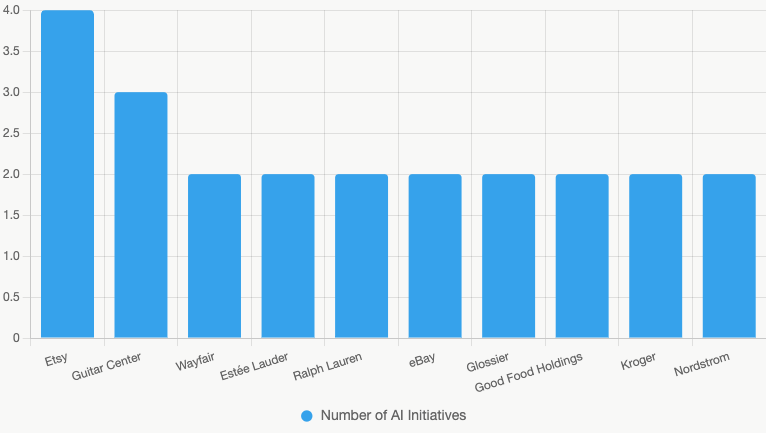
If you rank brands by number of distinct AI initiatives launched or expanded in 2025, one name rises above the rest:
Etsy was the most active retail AI adopter in 2025
Etsy didn't chase one "hero" feature. It treated AI like platform plumbing -- using it to protect what made Etsy human by removing the busywork around it.
Here's the breakdown of the other players active with AI deployments in 2025.
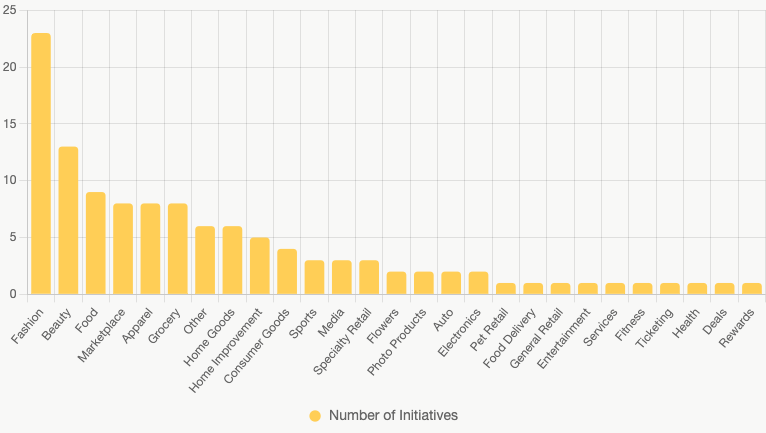
Sector distribution favored consumer-facing AI deployments.
---
What ROI was seen?
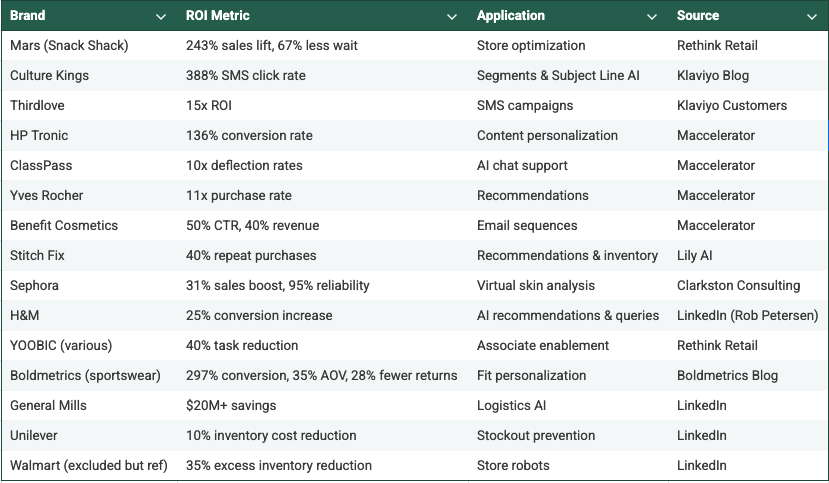
2025's ROI narratives were compelling.
- Mars' AI-optimized Snack Shack stores delivered a 243% sales increase alongside a 67% reduction in wait times (Source 1)
- Culture Kings' Klaviyo-powered SMS campaigns achieved a 388% click-rate boost
- Thirdlove's SMS ROI reached 15x -- the highest verified ROI observed
Across 15 verified ROI instances, results averaged high double-digit gains.
However, ROI was not universal:
- 93% of retailers faced data challenges (Source 2)
- Only 11% had mature customer data strategies
- McKinsey found the top 5% achieved 5%+ EBIT uplift (Source 3)
Case studies reinforce this split:
- Ulta Beauty unified loyalty data to increase spend
- H&M's AI agent resolved 70% of customer queries autonomously, increasing conversions by 25%
- Vitamin Shoppe used AI to improve internal team productivity
---
What the data says -- and where we're heading in 2026
What worked in 2025
- AI tied directly to existing workflows
- AI embedded into core surfaces (search, listings, pricing)
- AI that reduced labor, not just added UX polish
What didn't scale (yet)
- Fully autonomous shopping agents
- Standalone AI apps disconnected from catalog data
- Generic "chatbots" without merchandising logic, versus the best AI shopping assistants for ecommerce that stay tied to the catalog
Retailers learned quickly:
LLMs are powerful -- but retail is still a data and systems problem.
What to expect in 2026
- From features to agents: multi-step, goal-driven AI flows
- From experimentation to governance: stronger controls, bias handling, and QA
- From growth to efficiency: AI justified on margin, not novelty
I'll share more predictions for 2026 in my next post.
---
Full dataset
Table of all AI implementations by U.S. retail brands in 2025: View spreadsheet
Note: This table compiles publicly reported AI initiatives by U.S. e-commerce and retail brands in 2025 based on press releases, news articles, and company announcements available as of December 31, 2025. It is not exhaustive and may omit proprietary or unannounced implementations.
Sources
1. https://rethink.industries/report/ai-in-retail-report-2025/ 2. https://www.publicissapient.com/insights/generative-ai-retail-use-cases 3. https://www.mckinsey.com/capabilities/quantumblack/our-insights/the-state-of-ai